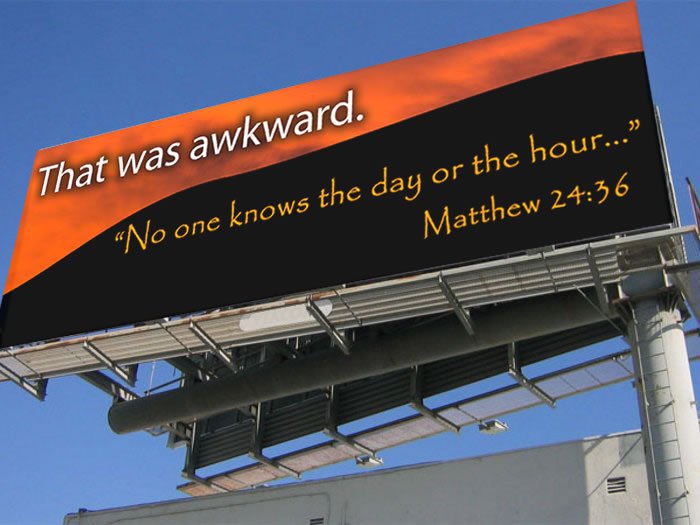
Camping Trip Cancelled!

Due to the fact he is a false teacher and a false prophet…

“Be ready, for the Son of Man is coming at an hour you do not expect.” Matthew 24:44

So millions wasted that could have gone to real authentic missions, now no billboards for the media to make fun of or conceited radio marathons, for the Bible told us, if only Camping and his misguided followers knew how to read…  “The day of the Lord so comes as a thief in the night. Another way God stated it” 1 Thessalonians 5:2 and  “Be ready, for the Son of Man is coming at an hour you do not expect.” Matthew 24:44

There it is, do you want to know when Jesus will return? The answer is simple, when he wants to and when we least expect it!

Will the rapture happen tomorrow, May 21st? NO!

First off, the rapture is not even in the Bible and people who think there is and have a date are only serving themselves or Satan and not the God of Scripture. In other words, Harold Camping is nuts at best or a servant at the devil at worst, either way do not listen to false teachers! Think I am wrong, just read the book of Jude. By the way, Camping has always been wrong with all of his predictions since I first heard him in the late 70’s he has never been right, what does the Bible say of this? …anyone got rocks-lol?

From Dan Wooding, 70, is an award winning British journalist…

Harold Camping Has Been Searching For The End Of The World For Some Time Now
A former associate shares about the time he worked for the self-appointed prophet

By Dan Wooding
Founder of ASSIST Ministries

EAGLE POINT, OR(ANS) As Harold Camping and his followers await the end of the world tomorrow (Saturday, May 21, 20110,) a former associate of the self-appointed prophet has revealed that this has been a long-running theme in Camping’s ministry.


Dr. Jim Krames, who was Camping’s assistant from 1978-80 said, “I knew him well and my technology mushroomed Family Radio’s s audience.” (Krames invented the Satellator, low-power FM broadcasting system).  

Krames said that it was while he was having lunch one day with Camping that he first announced “his propensity to date the Rapture.”  He said, “I spent several hours explaining why such an excursion was a very bad idea. He remained dissuaded for about ten years. In the meantime, I moved on to build two other networks.

“After the last fiasco when he predicted the end of the world for 1994, he ventured even more deeply into his inquiry into dates. He relies on King James Version (the only authentic translation in his opinion) for chronology, and he has the benefit of the fact that Hebrew letters also serve as numbers.  

“His background is engineering, so he tackles chronology problems as if unraveling a Suduko puzzle.”  Dr. Krames said the one day when he was having lunch with Dr. Bill Bright, founder of Campus Crusade for Christ, as his Arrowhead Springs headquarters, Bright asked him to describe Harold Camping. Krames said, “He is a man in whom there is no guile.”  

When asked to explain what he meant, Krames said, “My point is that although he hammers groups like Campus Crusade for Christ for what he perceives to be ‘easy believism’, his attacks have nothing to do with personalities, or anything. He sincerely believes what he says. He knows no other way to play it. Personally, I found him to be a selfless, caring man.

“Over the years, he has increasingly encroached into Family Radio’s broadcast schedule on a 24 hour regimen; he airs his bible study 4x, the reading of scripture, and his hour long call in talk show, family forum. Yet, today, Family Radio is probably the largest religious broadcasting network, with internet, on-air AM, FM, and Shortwave stations throughout the world.  

“His background is Dutch reformed and is traditionally, these people are ‘A-mill ‘(no millennium), just bang, Jesus returns, and court of last judgment begins. Early on, he withdrew from the congregation he had been active in.  

“His eschatological views on the start of what he views as the current tribulation began about a decade ago. At that time, he believes, the Holy Spirit exited all churches (including evangelical, Bible believing congregations). Therefore, he began to urge listeners that it was imperative that all true believers exit their church. In fact, he counts staying within a church, even solid, bible believing churches to be proof that you were not truly saved. This is why each Sunday’s broadcast schedule plays hymns, for which listeners can send in for a free hymn sheet (words).”  

Bill Freeman, from Orlando, Florida, shared this recollection about Harold Camping. He said, “In a phone interview I did within a day or two of Camping’s 1994 prediction while working at a DC-based radio network, my final question, ‘what if it doesn’t come about?’ elicited an answer that still leaves me aghast, ‘well, others have made predictions over the years…and they’re still around. Whew!”  

Dan Wooding, 70, is an award winning British journalist..

Do you think that the “rapture” is really in the Bible?

http://www.youtube.com/watch?v=JtrLNfMFayQ

Perhaps not! You may want to investigate this, Scripture in context, real word meanings… From 20 years of research at the Schaeffer Institute investigated this more thoroughly than anyone, now it seems the rapture is a made up myth and not in the Bible… But do not be like I did get all mad and think rebuttals to a rapture is nonsense, rather read and not read into the Bible what we want it to say…

http://www.churchleadership.org/apps/articles/default.asp?articleid=43936&columnid=4624http://www.biblicaleschatology.org/

What the Parable of the Tares Teaches us About the Rapture?

In a previous article, I showed that the wicked are taken out of the picture before the gathering of the Church. In this article, I will show that this teaching is also found in the parables of Jesus, particularly in the Parable of the Tares.

Matthew chapter 13 first records the Parable of the Tares (13:25-30) and then its interpretation by Jesus (13:36-43). The parable is about a farmer who had an enemy. When the farmer sowed his wheat, the enemy came during the night and sowed “tares” amongst the wheat. Tares are a kind weed commonly found in Palestine, also referred to as “cheat” or “bearded darnel.”

The servants of the farmer wanted to go through the fields and rip out all the tares, but the farmer stopped them saying that the process of tearing out the tares would only make things worse because the wheat would also be torn. They were to be allowed to grow together until harvest time and then the tares would be gathered first and thrown into the fire. This would be followed by the harvest of the wheat.

You’ve probably already guessed the meaning of this parable, but in case you haven’t, Jesus interprets it for us. So, we have here one of the few occasions when Jesus interprets his own parable for his disciples.

Jesus says that the sower is “the Son of Man” (v. 37), a title that He frequently used to refer to himself. The field “is the world” (v. 38). This parable is not talking about wheat and tares growing up together in the church, but in the world. The good seed represents the “sons of the kingdom” (v. 38). These are the redeemed, that is, the Church of God.

The tares represent the “sons of the evil one” (v. 38). These are the wicked, those who refuse to follow the Christ of God. The enemy is the devil (v. 39). The harvesters are the angels of God who will participate in the judgment of the world (v. 41). The harvest is the Day of Judgment when the tares are gathered up and “thrown into the furnace of fire” where there will be “weeping and gnashing of teeth” (v. 42).

The world is God’s field, but the devil will continue to sow wicked men and women in that field until the end of time. Christians are prohibited here from attempting to eliminate the wicked by force. Instead, the wicked and the redeemed are to grow up together until the day of harvest.

Now, in relation to the topic of this post, I come to the important question: WHO IS GATHERED UP FIRST, the Church or the wicked? Stop a moment before you answer that question. Go back to the text and read it. I’ll wait . . .

In the parable itself, the sower says to his servants: “First, gather up the tares and bind them in bundles to burn them up” (v. 30). In Jesus’ interpretation he says:

“The Son of Man will send forth his angels, and they will gather out of His kingdom all stumbling blocks, and those who commit lawlessness, and will throw them into the furnace of fire; in that place there will be weeping and gnashing of teeth. Then the righteous will shine forth as the sun in the kingdom of their Father (vv. 41-43).”

Did you notice the words that indicate sequencing? FIRST, the wicked are gather up and thrown into the furnace of fire. THEN the wheat (i.e., the children of the kingdom) are gathered into the barn.

Remember that the word “rapture” means “to be gathered up.” The only ones “gathered up” in the Parable of the Tares are the wicked. More importantly, they are gathered up BEFORE the believers are gathered into the Lord’s barn (v. 30).

Dr. Greg Waddell
Director of Institutional Improvement
Mid-South Christian College
DrGregWaddell (at) gmail.com

See his Blog: www.SpiritOfOrganization.com

THE WICKED ARE RAPTURED FIRST

AN EXPOSITION OF MATTHEW 24:41-42

You’ve probably heard the stories. A bus is heading down the highway when the bus driver and several passengers suddenly disappear causing the bus to veer off the road in a horrific explosion of broken glass and twisting metal. One of the pilots of a jet airliner disappears forcing the other pilot to take over the controls just in time to keep from crashing. It dawns on everyone that millions have vanished from the earth in an instant, leaving all those remaining with a sick feeling of dread.

Is this really what the Bible teaches will happen at the end of time?

Many evangelical Christians believe that a day will come when the saved will be removed from the earth without having experienced death, leaving behind all those who do not know Christ. I do not believe the Bible teaches this “Doctrine of the Rapture.” I’ve seen the supposed biblical evidence for it and I am not convinced.

In this post, I want to focus on Matthew 24:40-41, a passage that is often used to support the the rapture. I want to show that, in reality, this passage teaches exactly the opposite of what proponents of the rapture doctrine teach. The text reads:

“Then two men will be in the field; one will be taken and one left. Two women will be grinding at the mill; one will be taken and one left.”

It may appear that these words support the doctrine of the rapture as described above. However, those who interpret it this way have committed one of the classic errors of biblical interpretation; they have ignored the context in which these words are found. To understand that context, we must look at the words immediately prior to our text. Jesus says:

“For as in those days before the flood they were eating and drinking, marrying and giving in marriage, until the day that Noah entered the ark, and they did not understand until the flood came and took them all away; so will the coming of the Son of Man be” (Mat 24:38-39).

Jesus is comparing the days of Noah with the days immediately leading up to His second coming. Here is the key: Jesus says, “they did not understand until the flood came and took them all away; so will the coming of the Son of Man be.” The phrase “took them all away” is a translation of the word HEREN in Greek and it literally means to be “lifted up,” “taken up,” “carried away.” Our English word “rapture” comes from an archaic French root that originally referred to the “act of carrying away.” So, Matthew 24:40-41 is in fact talking about a rapture.

Here is my question: in the days of Noah, who were the ones raptured? Obviously, the wicked are the ones taken away by the flood. They are the ones who were eating, drinking, and getting married. They are the ones who “did not understand.” It is the wicked who are raptured by the flood unto destruction and the righteous remain in the safe protection of the ark.

Now, let’s read the text again:

“Then there will be two men in the field; one will be taken and one will be left. “Two women will be grinding at the mill; one will be taken and one will be left” (Mat 24:40-41).

If we take the context seriously, we are left with no choice but to understand that the ones taken are the wicked. Jesus is simply using another example to say the same thing he just finished saying in the Noah example. Two men will be in a field and suddenly, the wicked will be “raptured,” “taken away,” and the believer will be left in safety. Two women are grinding at the mill; the wicked woman is taken while the redeemed woman is left behind in safety.

If this is a correct interpretation of Matthew 24:41-42, then it dismantles one of the key arguments used by those who support the idea that it is the Christians who are taken first and that the wicked are left behind.

Dr. Greg Waddell
Director of Institutional Improvement
Mid-South Christian College
DrGregWaddell (at) gmail.com

See his Blog: www.SpiritOfOrganization.com

Farewell to the Rapture?


(N.T. Wright, Bible Review, August 2001.  Reproduced by permission of the author) 

Little did Paul know how his colorful metaphors for Jesus’ second coming would be misunderstood two millennia later. 

The American obsession with the second coming of Jesus — especially with distorted interpretations of it — continues unabated.  Seen from my side of the Atlantic, the phenomenal success of the Left Behind books appears puzzling, even bizarre[1].  Few in the U.K. hold the belief on which the popular series of novels is based: that there will be a literal “rapture” in which believers will be snatched up to heaven, leaving empty cars crashing on freeways and kids coming home from school only to find that their parents have been taken to be with Jesus while they have been “left behind.”  This pseudo-theological version of Home Alone has reportedly frightened many children into some kind of (distorted) faith. 

This dramatic end-time scenario is based (wrongly, as we shall see) on Paul’s First Letter to the Thessalonians, where he writes: “For the Lord himself will descend from heaven with a shout of command, with the voice of an archangel and the trumpet of God.  The dead in Christ will rise first; then we, who are left alive, will be snatched up with them on clouds to meet the Lord in the air; and so we shall always be with the Lord” (1 Thessalonians 4:16-17). 

What on earth (or in heaven) did Paul mean? 

It is Paul who should be credited with creating this scenario.  Jesus himself, as I have argued in various books, never predicted such an event[2].  The gospel passages about “the Son of Man coming on the clouds” (Mark 13:26, 14:62, for example) are about Jesus’ vindication, his “coming” to heaven from earth.  The parables about a returning king or master (for example, Luke 19:11-27) were originally about God returning to Jerusalem, not about Jesus returning to earth.  This, Jesus seemed to believe, was an event within space-time history, not one that would end it forever. 

The Ascension of Jesus and the Second Coming are nevertheless vital Christian doctrines[3], and I don’t deny that I believe some future event will result in the personal presence of Jesus within God’s new creation.  This is taught throughout the New Testament outside the Gospels.  But this event won’t in any way resemble the Left Behind account. 

Understanding what will happen requires a far more sophisticated cosmology than the one in which “heaven” is somewhere up there in our universe, rather than in a different dimension, a different space-time, altogether. 

The New Testament, building on ancient biblical prophecy, envisages that the creator God will remake heaven and earth entirely, affirming the goodness of the old Creation but overcoming its mortality and corruptibility (e.g., Romans 8:18-27; Revelation 21:1; Isaiah 65:17, 66:22).  When that happens, Jesus will appear within the resulting new world (e.g., Colossians 3:4; 1 John 3:2). 

Paul’s description of Jesus’ reappearance in 1 Thessalonians 4 is a brightly colored version of what he says in two other passages, 1 Corinthians 15:51-54 and Philippians 3:20-21: At Jesus’ “coming” or “appearing,” those who are still alive will be “changed” or “transformed” so that their mortal bodies will become incorruptible, deathless.  This is all that Paul intends to say in Thessalonians, but here he borrows imagery—from biblical and political sources—to enhance his message.  Little did he know how his rich metaphors would be misunderstood two millennia later. 

First, Paul echoes the story of Moses coming down the mountain with the Torah.  The trumpet sounds, a loud voice is heard, and after a long wait Moses comes to see what’s been going on in his absence.

Second, he echoes Daniel 7, in which “the people of the saints of the Most High” (that is, the “one like a son of man”) are vindicated over their pagan enemy by being raised up to sit with God in glory.  This metaphor, applied to Jesus in the Gospels, is now applied to Christians who are suffering persecution. 

Third, Paul conjures up images of an emperor visiting a colony or province.  The citizens go out to meet him in open country and then escort him into the city.  Paul’s image of the people “meeting the Lord in the air” should be read with the assumption that the people will immediately turn around and lead the Lord back to the newly remade world. 

Paul’s mixed metaphors of trumpets blowing and the living being snatched into heaven to meet the Lord are not to be understood as literal truth, as the Left Behind series suggests, but as a vivid and biblically allusive description of the great transformation of the present world of which he speaks elsewhere. 

Paul’s misunderstood metaphors present a challenge for us: How can we reuse biblical imagery, including Paul’s, so as to clarify the truth, not distort it?  And how can we do so, as he did, in such a way as to subvert the political imagery of the dominant and dehumanizing empires of our world?  We might begin by asking, What view of the world is sustained, even legitimized, by the Left Behind ideology?  How might it be confronted and subverted by genuinely biblical thinking?  For a start, is not the Left Behind mentality in thrall to a dualistic view of reality that allows people to pollute God’s world on the grounds that it’s all going to be destroyed soon?  Wouldn’t this be overturned if we recaptured Paul’s wholistic vision of God’s whole creation?              
           

 http://www.ntwrightpage.com/Wright_BR_Farewell_Rapture.htm 

[1] Tim F. Lahaye and Jerry B. Jenkins, Left Behind (Cambridge, UK: Tyndale House Publishing, 1996).  Eight other titles have followed, all runaway bestsellers.

[2] See my Jesus and the Victory of God (Philadelphia: Fortress, 1996); the discussions in Jesus and the Restoration of Israel: A Critical Assessment of N.T. Wright’s Jesus and the Victory of God, ed. Carey C. Newman (Downer’s Grove, IL: InterVarsity Press, 1999); and Marcus J. Borg and N.T. Wright, The Meaning of Jesus: Two Visions (San Francisco: HarperSanFrancisco, 1999), chapters 13 and 14.

[3] Douglas Farrow, Ascension and Ecclesia: On the Significance of the Doctrine of the Ascension for Ecclesiology and Christian Cosmology (Grand Rapids: Eerdmans, 1999).
Did the early Church Fathers teach a rapture or a particular position of it?


This has been a common source to prove one’s position regarding end-time scenarios. See what the early church taught and assume it must be fact since they were closer to the original source, Christ, and were not convoluted by centuries of theology. This is actually a good way to see what a theological position is and how it can be measured. The problem is, many do not actually read the early writings, and when one does, he/she does not always understand the language and word meanings and thus may make assumptions that are not there.

Concerning articles and pre-tribulation-ism claiming proof from early church sources. My goal is not to mock these ministry, but to point out a common error. I assume their hearts are in the right place, but may be misguided by faulty thinking and unsound research. This is the typical, sloppy scholarship that has penetrated the Church at large and deceived (or better put, “distracted”) and preoccupied many people with the wrong things.

This is what is called EisegesisIsogesis, which means “to lead in” or “reading into” the sentence; in the Scriptures, it is inserting an opinion that is not there. An example would be to introduce into the text one’s own presuppositions, ideas, and thoughts…where the reader or Bible teacher seeks an answer to his opinion or position to be varied. Thus he/she looks for verification and finds a vague reference, then does not bother to do his/her homework to truly determine what is actually being said…

The question is, did the early Church Fathers teach rapture? The answer is a clear no! I diligently studied their writings trying to prove a rapture theory and I never found it. Did they teach that all Christians will escape the Tribulation through a gathering to the Lord, or that they would go through it? Either position is possible, but highly unlikely, as the context and subject of these quotes and others is off issue or on a different subject than the position being inserted into the text. Also, the terms used then are not the same as what we use today and thus we make assumptions that are not based on fact. In other words, we assume and do not check out the facts, and thus make a dogma out of speculations and nonsense; in so doing, we miss the main point of it all.

This is the classic quote that is often used for both positions:

The Shepherd of Hermas.

You have escaped from great tribulation on account of your faith, and because you did not doubt in the presence of such a beast. Go, therefore, and tell the elect of the Lord His mighty deeds, and say to them that this beast is a type of the great tribulation that is coming. If then ye prepare yourselves, and repent with all your heart, and turn to the Lord, it will be possible for you to escape it, if your heart be pure and spotless, and ye spend the rest of the days of your life in serving the Lord blamelessly.

Is this evidence of pre-tribulation-ism and/or a rapture, or is it a pre-tribulation escape from the Tribulation? First, one needs to learn how to read, not a quip, but when we read, ask the question, what is it? What did that term or name mean then to the original author and audience, not what does it mean to me nearly two thousand years later, filtered with preconceived theological bias or a desire to prove some theory. We also need to look at the context and word usages. The same is with the other quotes like Brother Dolcino and the Apostolic Brethren statements. They are not saying a rapture, but speculating what might happen with a view that is not in Scripture, but may have some distant semblance to modern speculations that are also not based on Scripture. And, if one did some basic research, they would find that Brother Dolcino and the Apostolic Brethren were quickly refuted by scholars who did their homework. (By the way, these issues are so minor it is absurd we argue about them. By doing so, we disservice our Lord and take the attention off what He has for us.)

The real issue in Revelation and what this quote in Hermas alludes to is all about loyalty. The author tells us what is important, to not doubt in the presence of such a beast (meaning to not lose faith or doubt because one’s circumstances are tough. Beast refers to your opposition by political force or personal sin or persecution). Then, he states: prepare yourselves (meaning grow in faith), and repent (escape false thinking and embrace Christ as LORD) with all your heart, (make Christ first and foremost in one’s life) and turn to the Lord (lead your life as what Christ would have me do). This is about the continuing theme of our faith and allegiance, and about the contest and contrast of the mark of loyalty versus disloyalty. It refers to the loyalty of the faithful contrasting with the disloyalty of those who desire evil over the Way of God. If we try to read into this an end-time scenario, we miss the main point and delude ourselves. Further, if we teach this nonsense, we distract people from what is really important. We become the false teacher so refuted by 2 Peter. Read Matthew 24 and see what our Lord said about this. The point here is that God sees and protects those who are His (Rev. 3:12; 7:3-8; 13:16; 14:1-1; 22:4).

The true question to us all is not what esoteric theory best suits us; rather, will our loyalty and faith be to ourselves and/or evil, being easily led by manipulations, or will our allegiance be to the Lord and marked by Christ? Will our faith be about Christ as LORD or will our time and energies be spent on gibberish, distracting us and others away from faith, obedience, spiritual maturity, character, and Fruit?

Our trust in Christ (salvation) is what delivers us and daily life with the choices we make. This is not about esoteric whims; rather, it is about the practice of faith and trust and obedience in harsh times while still being loyal to Christ. This is what the Revelation was telling those seven churches and what it is telling us now.

How would you contrast loyalty versus disloyalty in your faith? What about how your church is run? How do you display loyalty to God and others?

These are the real issues; when we make up these foolish inconsequential theories, we take our eyes off Christ and place them on ourselves or something worse….we end up serving Satan or becoming a false teacher and flutter for our redactors and opponents while we forget about our Living LORD!

Rapture References

From the Books

  1. “The Early Church Fathers”
  2. The Shepherd of Hermas, 2; 23:5.(An early Church Father whom many say came up with this theory)
  3. Blackstone, William. Jesus is Coming (1878). Now published by Kregel (1989).
  4. Boyer, Paul. When Time Shall Be No More: Prophecy Belief in Modern American Culture (Cambridge, MA: Belknap Press, 1992), page 75.
  5. Benware, Paul. Understanding End Times Prophecy: A Comprehensive Approach (Chicago: Moody Press, 1995), pages 197-198.
  6. Ice, Tommy. “Morgan Edwards: A Pre-Darby Rapturist,” The Conservative Theological Journal, April 1997, pages 4-12.
  7. Denny, Timothy J. and Ice, Thomas D. “The Rapture and an Early Medieval Citation,” Bibliotheca Sacra, July-September 1995
  8. LaHaye, Tim. “Target Number One,” Pre-Trib Perspectives, September 2002, pages 1-3.
  9. Lindsey, Hal, The Rapture, Bantam Books (1983), p. 25
  10. Gundry, Robert, “The Church and The Tribulation”, Zondervan (1973)
  11. Scofield, C. I. The Scofield Study Bible (London: Oxford University Press, 1909).
  12. Larkin, Clarence. Dispensational Truth (Philadelphia, 1920).
  13. Keeley, Robin, Eerdmans’ Handbook to Christian Belief, Wm B Eerdmans Publishing, (1982), p.415
  14. Lindsey, Hal. The Late Great Planet Earth (Grand Rapids, MI: Zondervan, 1970).
  15. LaHaye Tim and Jenkins, Jerry. The Left Behindbook series.
  16. Chris Nelson. (200206-18). “A Brief History of the Apocalypse; 1971 – 1997: Millennial Madness” Retrieved on 200706-23.
  17. MacPherson, Dave. The Unbelievable Pre-Trib Origin (Heart of America Bible Society, 1973).
  18. MacPherson, Dave. The Incredible Cover-Up: Exposing the Origins of the Rapture Theories (Plainfield, NJ: Logos 1975)
  19. Rosenthal, Marv: “The Pre-Wrath Rapture of the Church: Is It Biblical?”, Regular Baptist Press (1991)
  20. Snobelen, Stephen D., Isaac Newton and Apocalypse Now. 2007
  21. “The World Did Not End Yesterday”, Boston Globe(Associated Press), 199210-29.
  22. Walvoord , John, “The Rapture Question, 1957.”

From the Web:

  1. “St. Ephraem”in the Catholic Encyclopedia on the Internet.
  2. Ed Reese, “Henry (Harry) Allan Ironside”

3. http://www.aroundomaha.com/sschool/rapture.html

4. http://www.geocities.com/lasttrumpet_2000/timeline/jeffrey.html

5. http://www.khouse.org/articles/1995/39/

6. http://www.bibleprophesy.org/ancient.htm

7. http://www.geocities.com/lasttrumpet_2000/timeline/ephraem.html

8. http://us.geocities.com/worldview_3/2tribchurch.html

9. http://bibleprophesy.org/jesuitrapture.htm

10. http://www.raptureready.com/

11. http://www.bibleprophesy.org/

12. http://www.raptureready.coml/

13. http://ag.org/top/Beliefs/Position_Papers/pp_4182_rapture.cfm

14. http://www.graceonlinelibrary.org/articles/full.asp?id=9%7C21%7C40

15. http://www.gonethefilm.com/

16. http://urbanlegends.about.com/library/blrapture.htm(this is here because it is funny and make an excellent sermon illustration to this article)

17. http://www.rapturefund.org/

18. http://en.wikipedia.org/wiki/Millerites

The Francis A. Schaeffer Institute of Church Leadership Development, www.truespirituality.org/, www.churchleadership.org/

Why so much rebuttal to a nonessential, theological concept?

Our critics and retractors use our foolishness against us in a big way. We give our enemies the bullets for our own downfall in reason, the relevance of faith, and the impact of the Church. To the thinking critic, who may have embraced Christianity if it was explained effectively and modeled effectually, sees religion as harmful. So say the secular humanists and contemporary philosophers from Bernard Russell to Kant (1872-1970 British philosopher and atheist), who said “He (Jesus) thought His second coming was to come before the death of people living at that time in clouds of glory.” His criticism was that it did not happen as Jesus (Matt. 10:23) said it would, or as preachers have interpreted. Thus, he argued that the Bible has no credibility. And on to Niche and the current attack on the Pledge of Allegiance.

The secular view is fueled by our unreasonable, irrational, ever-changing trends and infighting. This premise from our waywardness is we cannot know God, and Jesus did not exist or at best was a good teacher. Thus religion is destructive. Opponents point to the fanatic movements and wars over the century, ignoring the fact that it was not God but evil people using God’s name for their prideful gain. If they had proper instruction of what the Bible was saying, biblical Eschatology may have won the day.

Thinking that there will be rapture as taught by the TV preacher crowd and popular books is not unorthodox or heretical. Believe it as you may. I will keep buying cars with sunroofs as I used to call them “rapture roofs,” because if God wants to take us up in that way, He certainty may and can. If so, I hope it is when I am in traffic. A rapture is even not worth debating. There are far more important subjects to look at such as godly church leadership, effectual discipleship, and biblical literacy. But what it does is bad, just the same. Because it gets us, as Christian communities, continued infighting and/or focused away from what is really important, and that is the development and deployment of our faith. Focusing on the minors and forgetting about the majors just creates a major hole of personal and spiritual growth and very minor faith in our churches.

You may be as upset over this as I was; sorry. I do not want to be a party-pooper on end times. Yes, there will be a rapture of sort, but not the one from TV preachers; rather, it will be one far, far more magnificent.

One where Jesus Christ is truly glorified as He is coming back and we will be caught up in whatever way He sees fit. I firmly believe this will be far, far more impacting and spectacular than any wild, speculative theory that usually misses the main point. The main question is this: are you ready for His return?

If you disagree with me on this subject, we are still friends. I suspect this will be controversial. But as brothers and sisters in Christ, we can agree to disagree on these minors; let’s focus on the majors such as sharing the gospel and building up our faith. By the way, I will not respond to any emails or letters on this; I do not have the time. I have laid out my thoughts, references, and arguments in the best way I can. You can post your thoughts on this blog, or my other at intothyword blog, where I will read them. But my answer is this to any replies: Just got to the Word and remember context, context, and context; and it helps to look up words we may not understand.

The Rapture Question?

The rapture is not from the Bible, and not from valid sources; so why do so many people buy into it? It was not accepted by any denomination or godly theologian, or anyone who knew biblical languages and the Bible. Why? I think it was because it was exciting and people like a bit of excitement, especially if they do not know or get into the Bible They do not know the excitement an intimate relationship with God gives, so they look for substitutes by making up their own stuff or following others who do. By the way: every denominational and Christian group outside the Pentecostals rejected this doctrine until the 1980’s.

It has only gained popularity recently in the 1970’s when churches stopped teaching what’s in the Bible, solid doctrine, and how to study the Bible. Instead, “feel good” messages have filled our pulpits and airways as the sheep get fat on junk food and miss the main meals Christ has for us.

Many of these proponents seem to just quote other people who promote their views who quote other people and so forth. But the bottom line is this: no credible evidence in the Bible or in scholarship can be found. So where did it come from? Not from God!

The word rapture itself is not a good word to use for this event. That is why it was never used in church history by the greatest thinkers and expositors. Perhaps of the words used by Scripture, to be caught up is best; if you must have a term, “quickening” from the Old Irish seems best. Keep in mind that if you insist this is a true doctrine, this term came from false teachers who held a callous disregard to solid biblical doctrine and the rules of biblical interpretation. It is not a part of our Church thinking because most people today are not being discipled; they do not know the Word and thus buy this non-sequential thinking hook, line, and sinker because they do not know the difference. Others just go along with the rest of the non-thinking sheep, “bawing” to peer pressure. And shame on us preachers for not being more careful in presenting the Word of God!

The Purpose of the Rapture?

Yes, there will be a rapture, as in “caught up together to meet the Lord” as the Scriptures tell us.

But for us to argue its sequence and manner is just silly and misses the point. The purpose of “a rapture” from the Scriptures is not to vacate the earth, but to show Christ’s glory! It is not about us, it is about Him! The Church is not removed, rather is to participate in Him, to live in Him, to be marked in Him, to be identified in Him for His Lordship and lead here on Earth. Baptism means to be identified in Christ, yet so many Christians do not understand that either and thus fight over trivial meanings that baptism is not about. We do this with the Rapture too! We miss the point just as the Apostles did when they walked with Christ. But His Word is clear. Baptism is to be identified with Christ; mode and means are irrelevant.

Faith and action that lead to our obedience to be identified in Him is relevant. There is no way out of that if you read the Bible; the Rapture of the Church is all about Christ and His glory. It is not about us, our theories or a seven year tribulation or whatever ridiculous conjecture of the day might be. Christ is Lord; Christianity is about Him and how He seeks and saves us. It is not about us, our views or agendas. When we get away from our selfishness and pride and really surrender ourselves to look to Him, our Church will flourish and we will get the point of what He saves us for! This is what Biblical Eschatology is all about.