The Problem of Eisegesis

The predicament that motivated this twenty year research project is the systemic breakdown of Biblical true-Truth from the continual progressive lack of good honest teaching in Revelation and Eschatology in general. In most American Churches and ministries, there is a decreasing sense of a focus on what God’ really said, a lack of spiritual maturity as demonstrated by a lack of character, involvement and interest of deeper spiritual things. This is occurring at an epidemic rate while bad fads and dangerous trends are replacing solid Bible teaching and discipleship. 

There is too much sloppy exegesis and fraudulent Bible study and grandstanding and in conjunction too much reading in “Eisegesis” to glean what people want out of God’s Word. Thus, God’s people are attacking, even raping God’s word to create their own word and in the process distract His children away from perusing a deep spiritual formation with Christ by chasing nonsense and trivialities of man’s ideas are trivialities not following God’s (Acts 17:11; 2 Corinthians 4:2; and 2 Timothy 2:15; Revelation 22:18-19)!

As serious students of God’s Word the Bible we must know this great axiom, that to engage in honest and effectual Bible exposition, context, context and…one more…context, the historical, genre, textual…what does that term mean not just in the original language, but by the context of the language structure, what did it mean to the person who penned under God’s inspiration and who originally heard and read it…what does it mean elsewhere in Scripture… and so on…. Not what a madman in a suit is screaming on TV, thus we are relaying the research on this for your examination…

Our M.O. “modus operandi” is simply to seek out what the Bible has to say on Eschatology.  We have no ax to grind, no view to prove, we engage the Bible as humble learners. Thus, we seek the most honest and effectual approach is to engage the Bible without a preconceived view, to carefully research what is being said in context, word meaning, genre… Thus, an inductive exegetical approach is undertook, along side of deductive research to see what did that mean to the original writers and hearers and readers of it, not what we may think today. In this way, we can get a better picture of End Times and better embrace God’s most precious Word! 

Our focus primarily a critical and scholarly evaluation on the text and its context from the view of how it was understood in the time and culture from rigorous and sustained exegetical analysis (that is why this took 20 years). 

We will also consider the diachronic approach (i.e. the text’s phenomena interpretive history with its change through time, i.e. all the various views). The Inductive method that is employed is logical induction arising from inductance reactance of word meaning and context, and sentence structure proceeding from particular facts to a general conclusion. It is our attempt to take the principle inductive questions and seek what does the text plainly say, what does it mean and how does it apply today and weave it into a conversational presentation annotations and built points. Then, this induction is compared to logical deduction; “deductive reasoning” inferences from general principles from historicity, compared to others research evidence. We will also explore both the salient as well as the convergent and divergent views. I do not believe anyone has seriously done this; layout all the main views side by side next to the inductive and deductive research for each passage and then you can then make your own determinations.

http://www.churchleadership.org/apps/articles/default.asp?articleid=67933&columnid=4624

http://70030.netministry.com/articles_view.asp?articleid=43884&columnid=3801 

Do you read from the Bible or read into the Bible? Do you know the difference? 

 

The Methodology of our Eschatology

The Problem 

There is just too much bad and false teaching on this subject!  

Our point is to focus on what God says not what man says… we are the triviality when we distract others from Him. He is Sovereign… Thus, we look to Matthew 24, what Jesus clearly stated as our template, not heretical preachers or even what our denominations stated or what is popular…

The findings clearly show the more time in spiritual formation the increased joyful spiritual focus on Christ and effectual Christian living of the individual. Also what was asked is why is Eschatology important and how and why it is not important. The results of these questions were taken into account to the necessity of education of End Times precepts. 

It is the application of what Francis Schaeffer said as “true-Truth!” What does the Bible really say? Not what I think truth is, but willing to lay one’s truth aside for an honest investigation should not be feared; if you are right, Scripture will pan you out. If you are wrong, wouldn’t you rather be right on the side of the Bible, regardless of what others may think, or your own pride that may need to be swallowed? Then if you still feel your truth is correct and you did your homework, you are better off. But what usually happens is that we push our truth forward, ignoring logic, sound reasoning, and biblical exegesis such as, what did these terms and ideas mean in their original languages, set in their contexts, genre, and cultural meanings?

Our goal in our postings is: What did these words from Scripture mean to the human authors used by the Holy Spirit as well as the hearers at the time, not from a newspaper today that is at a different time, culture, and language.

This is what real effectual factual truth is in action and in application, asking the question what the bible clearly says in its actual meaning and context not what we think it should say.

The Essential Inductive Questions  

  1. What does this passage say?
  2. What does this passage mean?
  3. What is God telling me? How am I encouraged and strengthened?
  4. Is there a sin in my life for which confession and repentance is needed?
  5. How can I be changed so I can learn and grow?
  6. What is in the way of these precepts affecting me?
  7. What is in the way of my listening to God?
  8. How does this apply to me? What will I do about it?
  9. What can I model and teach?

10. What does God want me to share with someone? 

The Deductive Reasoning is as Follows 

  1. What does the word mean?
  2. What is the textual context?
  3. What is the genre context?
  4. What is historical context?
  5. Does it change anything?
  6. Does it indicate anything?
  7. What have others researched and taught on this passage?
  8. How does it add to your (and our) understanding?

Eschatology is important, why we have spent 20 years carefully researching and studying this, what is not important is crazy made up theory’s to satisfy ones pride…so we are not growing in the Faith and Fruit instead arguing with one another as the Gospel goes unnoticed…

Primary Sources, References and Resources used:

  1. The New American Standard New Testament Greek Lexicon from online and PC software based on Thayer’s and Smith’s Bible Dictionary, Kittel, Colin Brown and the “Theological Dictionary of the New Testament.”
  2. Richard J Krejcir. Into Thy Word. “Into Thy Word Bible Study Method.” Writers Club Press. 2000.
  3. Augustine. The City of God
  4. Calvin, John. The Institutes of the Christian Religion
  5. The Works of Early Church Fathers
  6. The Works Eusebius
  7. The Works of Justin
  8. The Works of Josephus
  9. Alan Johnson, Expositors Bible Commentary, I, II, Revelation. Zondervan. 1981, 1994.

10. Arthur Ogden, The Avenging Of The Apostles & Prophets, Ogden Publications, 1985

11. Barclay, William. Daily Study Bible: The Revelation of John. John Knox Press, 1977

12. Caird, G.B. Harper’s New Testament Commentaries: Revelation of St John, Hendrickson Publishers, 1987

13. Charles, R.H. International Critical Commentary: Revelation of St John, 1920

14. Craig S. Keener. The IVP Bible Background Commentary. Inter Varsity Press. 1993.

15. The Expositors Greek Testament, Eerdmans, 1979

16. Foy E. Wallace Jr., The Book Of Revelation, Wallace Publications,1966

17. G.B. Caird, A Commentary on the Revelation of Saint John the Devine, Harper and Row, 1966

18. Gerhard Krodel, Revelation, Augsburg, 1989

19. G.R. Beasley-Murray, The Book of Revelation, Eerdmans NCB, 1978

20. Halley’s Bible Handbook. Regency. 1927.

21. Hodge, Charles. Systematic Theology, Hendrickson, 1999

22. J. Dwight Pentecost, Things to Come, Zondervan, 1958

23. Jerome H Smith, Ed. The New Treasury of SCRIPTURE Knowledge. Thomas Nelson. 1992.

24. Jim McGuiggan, The Book Of Revelation, Montex, 1976

25. John F. Walvoord, Revelation, Bible Knowledge Commentary, Victor Books, 1983.

26. George Eldon Ladd, A Theology of the New Testament, rev. ed. ed. Donald A. Hagner, Eerdmans, 1993

27. Merill C. Tenney, Interpreting Revelation, Eerdmans, 1957

28. The Moffatt, New Testament Commentary: Revelation of St John, Eerdmans, 1997

29. Morris, Leon. Tyndale New Testament Commentaries: Revelation of St John, Tyndale, 1969, 1984

30. New Geneva Study Bible. Thomas Nelson. 1995.

31. Philip Schaff, History Of The Christian Church, Vol. I, Eerdmans, 1910,1985

32. R.C. Sproul. Essential Truths of the Christian Faith. Tyndale. 1992.

33. Sturgeon’s Devotional Bible. Baker Books. 1964.

34. Warren Wiersbe. With the Word. Oliver Nelson. 1991.

35. Research at the Scholarly Archives at Fuller Theological Seminary in Pasadena, CA; Years of study & teaching notes; Seminary notes; Prayer

The primary exegete is Rev. Richard Joseph Krejcir, M.Div., Ph.D., is the cofounder and Director of Into Thy Word Ministries, a missions and discipling ministry. He is also the theologian in residence, at the Francis Schaeffer Institute of Church Leadership.  www.churchleadership.org/  He is the author of several books including, Into Thy Word, and A Field Guide to Healthy Relationships. He is also a pastor, teacher, and speaker. He is a graduate of Fuller Theological Seminary in Pasadena, California (M.Div.) and holds a Doctor of Philosophy in Practical Theology in London, England (Ph.D). He has garnered over 30 years of pastoral ministry experience, mostly in youth ministry, including serving as a church growth consultant. 

Do you read from the Bible or read into the Bible? Do you know the difference?


Thank-you for all for your attention and contributions and be blessed!


The Many Rooms of John 14

So, life hurts? Theories of end times have you overwhelmed and confused; perhaps frustrated that what we are discussing goes against many Christian mindsets (because we go to the Bible not to a paradigm)? Remember this, it is not about a view for eschatology, it is about Who and What Christ is doing for us. What is that?… 

          In the science and art of eschatology, there so many variant views, and the pride and the megalomaniac personalities involved, we often forget the Who and the Why of it all. Of course it is all about our Lord and Savior, our Judge and Redeemer, Who is still to come, Who has already paid for us….It is all about Christ as LORD!  

I am the Way, I am the Truth, and I am the Life! No one can come to the Father except through Me! 

          If eschatology is important, one must take from what Scripture states plainly, and embrace the wonder of our Lord and not the feebleness of our theory’s so we can get the main point. One of these main points is that when we pass away or He retunes to claim check us, we will enter into eternity. We will dwell in Him for eternity.  

Jesus fourteen tells us that, In Heaven there will be many rooms in My Father’s Home, one made up especially for each of you! I will prepare it personally and at the right time, I will come and get you and you will always be with Me. You will know all about it and how to get there.

The word, Father’s house, means, as one may surmise, Heaven where God’s presence dwells with us, as opposed to Hell where God’s presence is absent. This is our ultimate future hope and residence, our future reward and our current motivation to pursue righteousness. What eschatology must point to. Classically in Judaism, this meant the Temple, God’s dwelling on earth, where God dwelt amongst His people. How Jesus uses this term, it is our ultimate carrot on the stick, our mega reward. He is telling us about our heavenly dwelling place that God prepares for us that no mere human words could ever describe (Ezek. 43:7-9; 44:9-16; 48:11, 35; Luke 16:9; John 8:35; 14:28; Acts 1:10-11; Rom. 5:2; 1 Cor. 15:16-19; Heb. 7:25; 1 Pet. 1:3-5; 1 John 2:1).

So what is heaven going to be like? Well, beyond any words or theory could ever explain. But we are given a foretaste.

The key word of many rooms or mansions, means to dwell and remain in God. Heaven is about us being with Christ! This is figurative language because this “non-corporeal” (not a normal flesh and blood human existence) or metaphysical wonder can’t be explained in human language. In addition, “small” does not mean “limiting” here. This is also a fulfillment of the celebration of the “Feast of Booths” that acted in converse to God dwelling in the Temple as people lived in tents to dwell with God (John 2:21; 14:16-23; 15:1-7; 1 Cor. 2:9; 4:5; Col. 3:18-4-1; Rev. 22:12).

What is Christ doing for us? He is preparing a place. Jesus is preparing for us, those He chooses, an eternal home; Heaven.

This is not just a residence; rather proof that God will completely and thoroughly accomplish and achieve His purpose throughout the universe. He will bring all things to fruition. He brings peace and a future to those in Him. Thus, God will achieve His purpose; we will inherit His wonders and blessings and we will have no ties to the old nature of sin and evil. Jesus is not just preparing a place for us in Heaven; He is preparing us by our journey of faith in the here and now too (Isa. 42:9; 48:6; 51:15-16; 65:17-25; 66:22; 1 Cor. 15:35-57; Rev. 7:9; 21:1-8)!

This is also what we receive, our reward for all that we have done and endured for Christ and His children and the opportunities He gave us. This is what we look forward to, our dwelling with Christ, and what can also motivate us in the here and now.

Does John 14 teach a Rapture?

Many people in an attempt to prove a rapture will often cite the NIV translation of John 14:3, “Take you” as a proof that we will rise up to meet Jesus. First off, that would be cool and I am hoping for that. But, I have to be honest to the Text and only teach what the Bible, in proper context, acutely says from actual word meanings inductive analysis, especially what did that term(s) mean to a first century Jew and Roman. What we do not what to do is disrespect God and His Word by seeking, “what I want it to mean for me.” Because we will then, draw wrong conclusions and as Bible teachers lead people astray. What we want to do is appropriate and effectual applications from the Text of God’s most holy Word, then grow ourselves and the people that God gives to disciple deeper to His heart and true Truth for His glory. 

So what is going on in John 14?  

The NIV states, “And if I go and prepare a place for you, I will come back and take you to be with me that you also may be where I am.” Verse 3 

The NASB states, “If I go and prepare a place for you, I will come again and receive you to Myself, that where I am, there you may be also.” 

The Greek word is “paralambano”          it is a verb meaning “to take to,” as to take with one’s self, to join an associate or a companion (from Kittel’s “Theological Dictionary of the New Testament,” the definitive work in this matter). 

Remember context, this was Jesus’ “Farewell Discourse” where He gives His most passionate and important instructions to His Disciples and us. He was facing betrayal and He turns to His Disciples to comfort them and says; do not be afraid or troubled! Trust in God; trust in Me. He then gives them a picture of hope by showing them a glimpse of what Heaven will be like. He is giving us a picture of the greatest carrot on a stick for us, Heaven, is that inheritance God is promising us beyond our scope of understanding. How incredibly wondrous this must be; our place and security is in Heaven to come and our joy can then be declared and lived out.

He was imparting one of His most important messages, to trust in God. He was giving a call to a personal relationship-unity with conviction with Himself, The Christ. “Trust” is a command to step up to faith, our response to the call of God with conviction in Him through times of danger and fear. Jesus wants us to grasp a picture of a righteous person’s proper dependence upon Jesus as He is exemplified. That He is our Sanctuary; He is the Eternal God on whom we can rely and not only give our life to, but also live our life for (2 Sam. 2:3; Isa. 8:17; 28:16; Psalm 118:22; Isa. 8:14-18; 28:16; John 13:36; Heb. 2:13).

In addition, Jesus was communing the importance to the pursuit of righteousness as like with one journeys through the wilderness of the tough times of waiting and confusion-even suffering. He is giving us a beacon and we are to focus on Christ. That he is Truth in this context means He fulfills the Law and teachings of the Old Testament. That He is Life, there is no existence without Him and there is no salvation without His atonement, redemption, and grace. Christians were first called “the Way” (Ex. 16:33; Lev. 10:2; 16; Num. 17:5; Matt. 7:14; John 1:1-4, 14; 3:16-18; 5:26, 33; 11:25-26; 18:37; Acts 4:12; 9:2; 19:9, 23; Rom. 10:14-15; Eph. 2:8-9; Heb. 10:19-20;1 John 5:12).

 Consequently, “to take” means a call to join our Companion because He is Lord, and referring that Jesus is our only way, the gate and stairway to Heaven; there is no other way to God except through Him. The real intended meaning was about the resurrection of the dead leads to a new life, our life after death that Jesus is able to provide by His death and resurrection. This passage has nothing to do with a rapture, it is all about Christ and we are to focus on Him not trends, trivialities or speculations.

With the context of heaven, this can also refer to the Second Coming or the new age of the fulfillment of the Kingdom of God. But, moreover, this is about Jesus as our Rescuer and Redeemer; He took on our human nature but without our sinfulness, and remained pure to pay the debt for our sins. In the process, His human nature voluntarily became lower than the angels, but as Fully God He is superior to them in essence, power, purpose, and distinction (Rom. 1:4; Heb. 1:1-4; 2: 7, 14-15).

Yet, this passage has been greatly abused by many so-called pastors who read it out of context and inserted their own feelings as truth. Rather, this is an invitation to radical faith. Jesus is saying we can trust in Him totally and completely with all we have now and for our future. Because, He is not just preparing a place for us in eternity, He is preparing us for eternity too! What we go through is not just about sin in an unfair world, it is the building up of faith and being that display a beacon to a dimly lit world that needs His Light.

Keep in mind, that the study of eschatology can be important, but, compared to issues such as prayer, Bible study, who Christ is, basic doctrine, faith development, living in the Spirit, and growing in character and service to our neighbors and people in need, it really is not that important for us to know or to teach! It is OK to disagree with non essential doctrine, as long as we do not divide over it!

How to tell if someone is a False Teacher or Prophet?


The usual, the teaching is not drawn from Scripture; rather read into to fit their wayward theory. Pride is always a good indicator, a true servant of the Lord points to Christ and not themselves. And of course what they predict does not come true. Then after the false prophecy, they are silent for a while, hoping you forget and then wow you with a new date or teaching… They feed on those who do not read the Bible and do not think. In addition, 1 Peter gives us the main template of the false teacher and prophet, by showing us what a real one is like:  

Concerning this salvation, the prophets, who spoke of the grace that was to come to you, searched (the Scriptures) intently and with the greatest care, trying to find out the time and circumstances to which the Spirit of Christ in them was pointing when he predicted the sufferings of the Messiah and the glories that would follow. It was revealed to them that they were not serving themselves but you, when they spoke of the things that have now been told you by those who have preached the gospel to you by the Holy Spirit sent from heaven. Even angels long to look into these things. 1 Peter 1:10-12

They searched the Scriptures, not forced presumptions into the Text. They taught what God told them too, not what they wanted to. They shared and lived out the Grace of our Lord, they preached the Gospel, and they pointed to Christ not making a name for themselves… 

“It was revealed” is about the mysteries to which God gave the O.T. prophets a glimpse—of things to come that were to benefit and encourage future generations, like us today. For us, a real prophecy or a Gospel teaching is the Message of the Gospel, the true Truths directly from God’s Word the Bible being infused by the Holy Spirit and then lived out in our lives; it is that Jesus Christ, being fully God, lived in behalf of us, took our place for God’s wrath, suffered in our place, and redeemed us. It is a call to us to be the messengers of the Gospel along with the Holy Spirit (Luke 24:25-27, 45-47). 

God wants us growing in Him, not speculating on nonsense and wasting Kingdom time and ‘debating’ others away from the faith. He wants us to be contagious with his Truth and grace. He wants to see if our faith and commitment is real and brings us into situations where we can learn and grow in faith and so receive our reward. God’s purpose is to refine us, form us, mold us, improve us, restore us, grow us, and strengthen us. This we need to pray and contemplate our attitude, mindset, and deeds so we can make sure we are pointing to Christ and not ourselves. We are to seek our repentance and so we will “wake up,” see our error, and seek Him (Gen. 11:1-f; Deut. 8:2; 13:3; Judg. 2:22; Job. 23:10; Rom. 5:3; James 1: 2-4, 12-16; 1 Pet. 4:17; 5:1-4, 8).


Rapture ready?

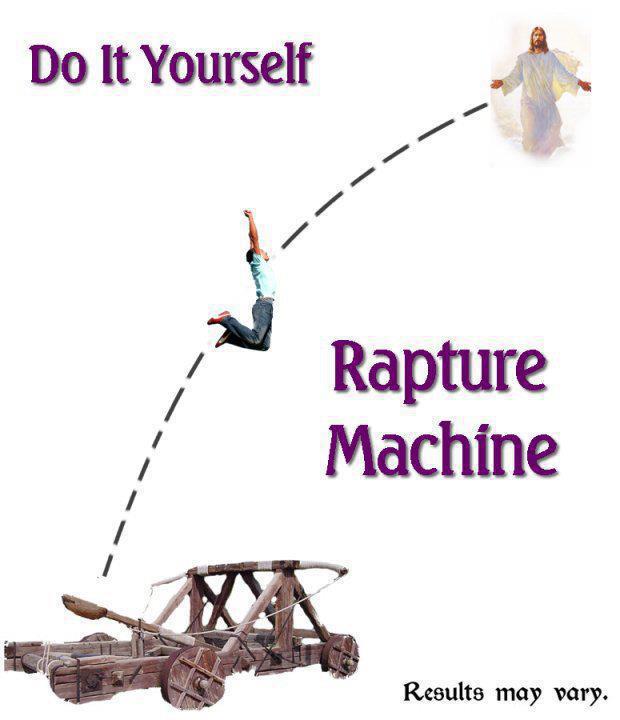
For those who just can’t wait…. For those of you who can’t find it in the Bible, even after decades of looking… For those who think some Christians are just too ridiculous… For those who take their unessential theology too seriously…. Here is an idea…and the best part- you will see Jesus…!


(Illegal or is it legal disclaimer: “warning, results may vary! Consult legal counsel and a psychiatrist before being proactive with this venture… This is purely an dumb attempt at wit- not to enlist debate or conjecture….” For actual ‘end times’ theology just read Matt. 24, for debate see https://biblicaleschatology.org/rapture/) lol

Seeking End Times Trends is Fruitless PIII

A look at Mathew 28 as it relates to end Times 

Jesus is risen—He is risen indeed—Hallelujah!  

           Jesus has all authority! He proved this by not only being God, but by being willing to come as a man to this earth and live the life we could not, nor would not do. He overcame our sins and our enemies (John 12:31; 16:33; Rom. 6:1-7; Rev. 1:17-18)! He kept His promise that He made to Adam to redeem us, and then He sent the Comforter to lead us on (Acts. 1:3; 2:24-35; 3:15; 4:10; 5:30-32; 13:33-37)! Jesus is risen. This means He conquered death (Acts 2:24; Rom. 1:4; 1 Cor. 15:50-58). We too, in Him, will undergo a similar transformation, as we live for Him, forgive in His name, are justified (Rom. 4:25; 1 Cor. 15:17), and will arise in eternity (John 11:25-26; Rom. 6; Eph. 1:18-2:10; Col. 2:9-15; 3:1-4; 1 Thess. 4:14-18; 1 Pet. 1:3).  

          Without the resurrection, we do not have Christianity—as in saving faith.

We just have some great rules and precepts to live by. Well, so do the Buddhists (1 Cor. 15:1-19)! A dead man, no matter how good and great, cannot save anybody. Buddha has saved no one! The difference is we are transformed, and saved for eternity—not just for here and now (John 10:4; 16:10; 2 Cor. 5:20). We are not called to save souls. That is the role of the Holy Spirit. Rather, we are called to help the “soul bearers” to learn and grow! 

          The people then, as well as now, were confused about the end times and wondered if this was the end of an age or a new beginning.

Jesus did not fit the expectations of the religious leaders or of His disciples. The religious leaders rejected Him. The remaining disciples had to surrender their will to His in order to know who He was and what He was doing in them (John 3:30). We cannot make disciples of others until first we, ourselves, become disciples of Jesus (2 Pet. 1:13)! The disciples bore witness to His call to make disciples of all nations; they were His witnesses and His messengers. What will you do about this today (Acts. 1: 22; 4:2, 10, 33; 2 Cor. 5:20)? The key to implement this is to realize who Jesus is—and His authority! When we have acknowledged His authority, then we can allow His work in us. Then, He can use us in the lives of others. The opportunities and potentials are limitless (Luke 10:17-20; John 15:7; Acts 20:24)!  

Questions to ponder that are more important… 

What can you do to help your church see the veracity of The Great Commission and do a better job of knowing Christ so they can then make Him known? What would your church look like doing this? What would your neighborhood look like? Verses just talking about your favorite end time’s scenario?  

What does Jesus’ statement, all authority, mean to you? How can this get deeper in you so you understand further that He is God, He is all powerful, He is all knowing, and, He is present everywhere? What would that mean to your spiritual walk with Him?  

Jesus tells us He will always be with you. How can this help give you motivation and comfort?  

What does make disciples mean to your church? What has your church done with Christ’s most important call? Why do so few churches and Christians do this? Why is this more important than a ‘correct’ and of course most if not all are not) view of End Times?  

What makes this passage the marching orders for our faith and practice? What have you done? Where are you lacking? What do you need to do?  

Do you believe that if you are committed to your beliefs (those that are not focused on Christ), and refuse to allow the Holy Spirit to convict you, you will remain in your sins and be unsaved? Why, or why not? If so, why?  

What are the barriers that keep you from knowing Christ? If your beliefs were untrue, would you want to know?